

The RDA is a minimum, not a target
The Recommended Dietary Allowance (RDA) of 0.36 grams of protein per pound of bodyweight per day is set to prevent deficiency in a sedentary adult — it's the amount your body needs to avoid slowly losing muscle, not the amount that supports fitness, muscle building, or an active weight-loss phase. Sports nutrition research from the International Society of Sports Nutrition (ISSN) consistently finds that active people benefit from meaningfully more.
The four goal-based ranges
Rather than one universal number, protein needs scale with what you're actually doing:
| Goal | Typical range (g/lb bodyweight) |
|---|---|
| Sedentary (RDA) | 0.36 (0.45–0.54 if 65+) |
| General fitness | 0.54 – 0.73 |
| Muscle gain | 0.73 – 1.00 |
| Fat loss (cutting) | 1.00 – 1.27 |
Notice the range goes up, not down, during a calorie deficit. Extra protein while cutting calories helps preserve lean muscle, so more of the weight you lose comes from fat rather than muscle — which is why "cutting" sits highest of all four goals, above even muscle gain.
A worked example
Take a 180 lb person training for general fitness at 0.64 g/lb: that's about 115 grams of protein a day. The same person shifting to a muscle-gain goal at 0.86 g/lb would target roughly 155 grams instead — same bodyweight, different number, because the goal changed.
Why age changes the number
The PROT-AGE Study Group — a panel of aging and nutrition researchers — recommends that healthy adults aged 65 and older aim for 0.45 to 0.54 g/lb of bodyweight daily, meaningfully above the standard 0.36 g/lb RDA. The reason is sarcopenia: the gradual loss of muscle mass and strength that comes with aging. Higher protein intake, especially alongside resistance exercise, helps counter that decline. If you're already following an active goal (General fitness and above already sit at or beyond that 0.54 g/lb threshold), the age adjustment doesn't add anything extra — it mainly matters for someone who would otherwise be using the plain 0.36 g/lb sedentary baseline.
Pregnancy and breastfeeding
Protein needs rise during pregnancy and lactation, on top of whatever activity-based goal applies. The RDA reflects this as an absolute addition: pregnancy adds about +14 grams a day (from a 46 g to a 60 g reference RDA), and breastfeeding adds +25 grams a day. These are added on top of your regular goal-based target, not a replacement for it.
Total bodyweight vs. lean body mass
Every range above is normally expressed per kilogram of total bodyweight, which works well for most people at a typical body fat level. But fat tissue is metabolically far less demanding than muscle — it doesn't need anywhere near as much protein to maintain. At a higher body fat percentage, a total-weight target can meaningfully overshoot what's actually needed.
If you know your body fat percentage, re-basing the calculation onto lean mass is the more accurate approach — the Protein Intake Calculator does this automatically once you enter it. Don't know your number? The Body Fat Calculator estimates it from a tape measurement in under a minute.
Spreading protein across meals
The daily total matters most, but research on muscle protein synthesis — the process that builds and repairs muscle tissue — suggests each meal needs a meaningful dose to trigger it effectively: roughly 0.18 g/lb of bodyweight, spaced about 3–4 hours apart. Getting your entire daily total from one large dinner is less effective than spreading it across 3 to 5 meals of a reasonable size each.

Real-world food equivalents
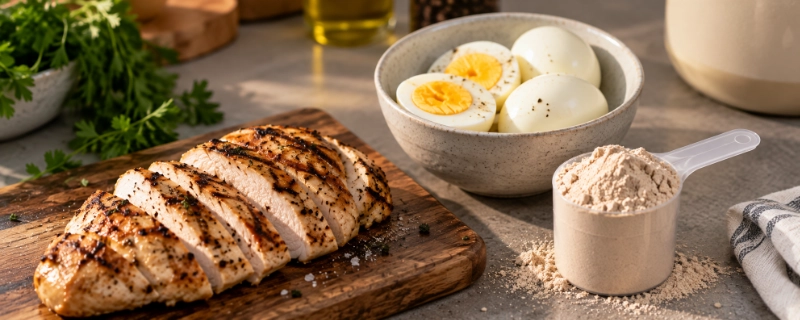
A number in grams is hard to picture on its own. As a rough guide, one large egg has about 6 grams of protein and a cooked chicken breast has about 46 grams — so a 115-gram target is roughly equivalent to 2.5 chicken breasts, or 19 eggs, if you got the entire amount from just one source. Nobody eats only chicken or only eggs, of course — in practice your total comes from a mix of meat, dairy, eggs, legumes and other sources across the day, but seeing the single-source equivalent makes the abstract number concrete.
Frequently asked questions
How much protein do I need per day?
It depends on your goal, not just your weight. The RDA baseline is 0.36 g/lb for a sedentary adult, but most active people benefit from 0.54–0.73 g/lb, and those focused on muscle gain or fat loss typically do best around 0.73–1.27 g/lb.
Is more protein better for muscle gain?
Only up to a point. Research generally supports about 0.73–1.00 g/lb of bodyweight per day for building muscle — intakes above that don't show a clear extra benefit for most people. Spreading it evenly across 3–4 meals matters as much as the daily total.
How much protein should I eat to lose weight?
Higher than maintenance — typically 0.91–1.27 g/lb of bodyweight while cutting calories. A higher protein intake during a deficit helps preserve lean muscle mass so more of the weight lost comes from fat rather than muscle.
Do older adults need more protein?
Yes. The PROT-AGE Study Group recommends 0.45–0.54 g/lb of bodyweight for healthy adults 65 and older, above the standard 0.36 g/lb RDA, to help offset age-related muscle loss (sarcopenia).
Should I use my total weight or lean body mass?
Total bodyweight works fine for most people at a typical body fat level. If you know your body fat percentage, switching the calculation to your lean body mass is more accurate, since fat tissue needs far less protein than muscle.