
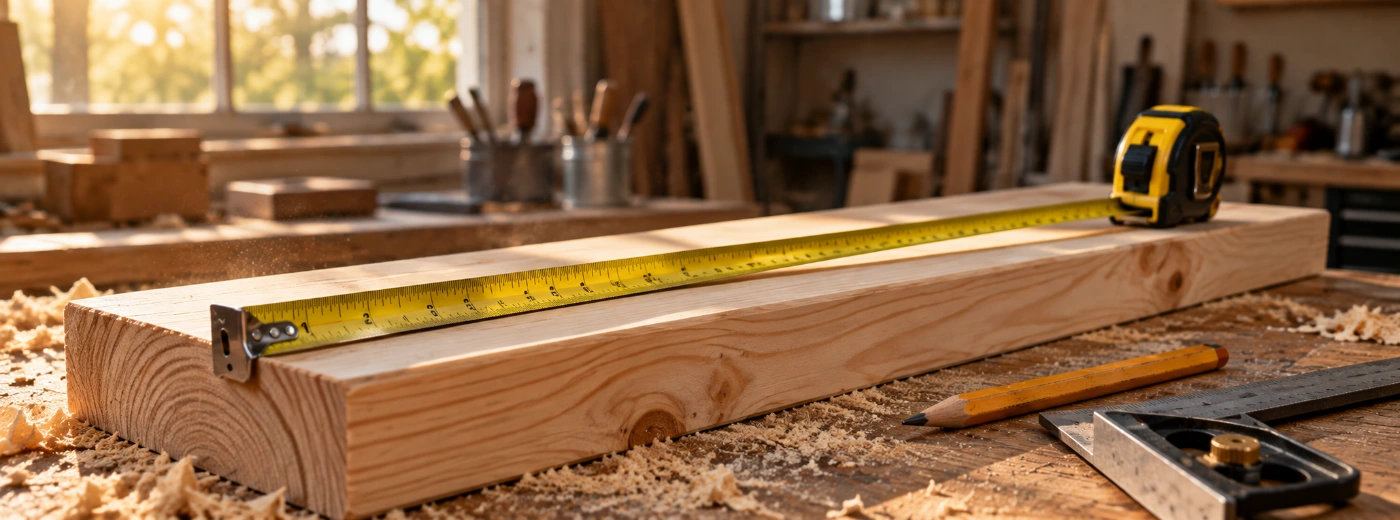
Reading the fraction marks on a tape measure
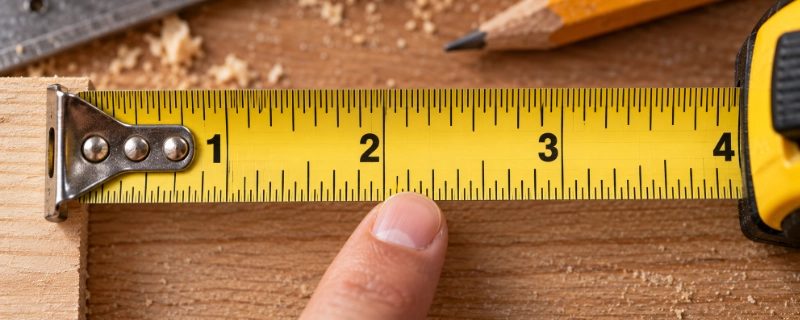
Between each inch line, a standard tape measure is divided into smaller ticks: a half-inch mark (the longest tick between two inch numbers), then quarters, then eighths, then sixteenths (the shortest ticks). Some tapes go finer, to thirty-seconds. Every tick is a fraction of an inch counted from the last whole inch — the fourth small tick past the 5" line is 5 4/16", which simplifies to 5 1/4".
The habit that prevents most misreads: count ticks from the nearest whole inch, not from the start of the tape, and always note which denominator you're counting in (8ths, 16ths, 32nds) before you write the number down.
Finding a common denominator before you add
You can only add or subtract fractions that share the same denominator. If one measurement is in eighths and another is in sixteenths, convert the eighths to sixteenths first by doubling both the top and bottom number: 3/8" = 6/16". The rule is simple — multiply numerator and denominator by whatever turns the smaller denominator into the larger one.
Adding two measurements, step by step
Add feet, inches, and fraction numerators separately, then clean up the result:
- Convert to a common denominator. Rewrite every fraction with the same bottom number.
- Add the numerators. Keep the feet and inch columns separate for now, just like adding whole numbers in columns.
- Simplify or borrow. If the fraction total is 16/16 or more, that's a whole inch — carry it into the inch column and keep the remainder as a fraction. If the inch total reaches 12, carry a foot the same way.
Example: 3' 7 5/8" + 2' 4 7/8". Convert both fractions to eighths (they already are): 5/8" + 7/8" = 12/8", which is 1 4/8 = 1 1/2". Carry that inch: 7 + 4 + 1 = 12 inches, which is 1 foot. Feet: 3 + 2 + 1 (carried) = 6 feet. Result: 6' 0 1/2".
Subtracting a measurement — working out an offcut
Subtraction works the same way in reverse, except when the fraction or inch you're subtracting is bigger than the one you're subtracting from — then you borrow instead of carry. Borrowing an inch means adding a full denominator's worth to the fraction (16/16, 8/8, whatever you're working in) before subtracting.
Example: a board is 8' 2 1/4" and you cut a piece 5' 7 5/8" long. You can't take 5/8 from 1/4 (which is 2/8"), so borrow an inch from the 2: it becomes 1", and the fraction becomes 2/8" + 8/8" = 10/8". Now 10/8" − 5/8" = 5/8". Inches: you now have 1 inch left (after lending one to the fraction), and you need to subtract 7 — so borrow a foot too: 1 + 12 = 13, and 13 − 7 = 6". Feet: 8 − 1 (borrowed) − 5 = 2'. The offcut is 2' 6 5/8".
Converting to decimal inches or centimetres
To go from a fraction to a decimal, divide the numerator by the denominator: 5/8" = 0.625". Add that to the whole-inch count, then add 12 times the feet if you need total decimal inches. For centimetres, multiply the total decimal inches by 2.54: 89.375" × 2.54 = 227.0 cm. This is useful when a reading needs to go into a CNC program, a CAD drawing, or a metric spec sheet.
Splitting a board into equal parts
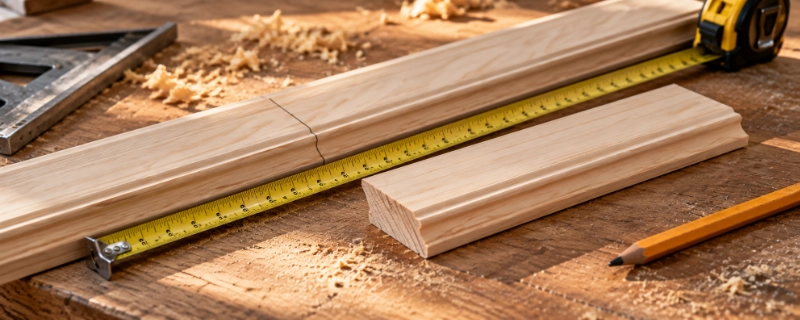
To space marks evenly along a length — fence pickets, shelf pins, baluster spacing — divide the total length by the number of parts, in decimal inches for accuracy, then convert each part back to a fraction at whichever precision your tape reads. A 7' 4" rail split into 3 equal parts is 88" ÷ 3 = 29.333..." each, which rounds to 29 5/16" at sixteenth-inch precision — mark that distance from one end, then again from that mark, for two evenly spaced cut lines.
Common mistakes that throw off a cut list
- Adding fractions with different denominators directly. 1/4" + 1/8" is not 2/12" — convert to a shared denominator (2/8" + 1/8" = 3/8") first.
- Forgetting to carry or borrow. A fraction total of 18/16 is 1 2/16", not "18/16 inches" — it has to roll into the inch column.
- Misreading which tick is which. The longest unlabeled tick is always the half-inch; counting ticks without noting the denominator is the most common source of a 1/16" error.
- Rounding too early. Round only the final answer, not each fraction along the way — early rounding compounds across a long cut list.
A worked example, start to finish
Question: a cut list needs three pieces — 3' 7 5/8", 2' 4 7/8", and an offcut of 1' 2 3/8" removed. What's the total?
| Step | Working | Result |
|---|---|---|
| Add piece 1 + piece 2 | 3' 7 5/8" + 2' 4 7/8" | 6' 0 1/2" |
| Subtract the offcut | 6' 0 1/2" − 1' 2 3/8" | 4' 10 1/8" |
| As a decimal | 4 × 12 + 10.125 | 58.125" |
| In centimetres | 58.125 × 2.54 | 147.6 cm |
The tape measure fraction calculator runs a running total like this automatically, shows the exact tick on a live ruler, and handles the carrying and borrowing for as many entries as a cut list needs.
Frequently asked questions
How do I add fractions on a tape measure?
Convert every fraction to a shared denominator, add the numerators, then carry any total of a full denominator (16/16, 8/8, etc.) into the inch column, and any inch total of 12 into the foot column.
How do I subtract a smaller fraction from a bigger one on a tape measure?
If the fraction you're subtracting is larger than the one you're subtracting from, borrow a whole inch and convert it into the fraction's denominator (an inch borrowed in sixteenths becomes 16/16) before subtracting.
How do I convert a tape measure fraction to a decimal?
Divide the numerator by the denominator — 5/8" becomes 0.625" — then add it to the whole-inch count. Multiply the total decimal inches by 2.54 to get centimetres.
What's the smallest fraction a tape measure shows?
Most tape measures mark down to 1/16 inch. Some mark 1/32 inch. Finer than that, a machinist's rule or digital caliper is needed instead.
How do I split a board into equal parts using a tape measure?
Divide the total length by the number of parts in decimal inches for accuracy, then round each part back to a fraction at your tape's precision, and mark that distance repeatedly from one end.