
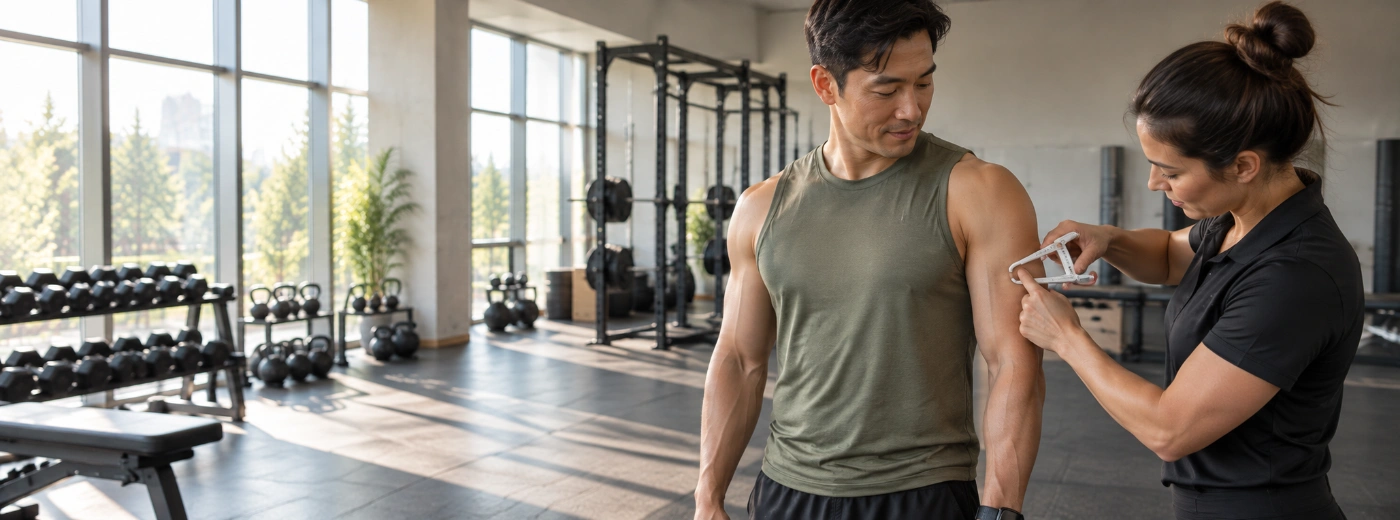
What Is Body Fat Percentage?
Your body fat percentage is the proportion of your total body weight that is fat mass. Everything else — muscle, bone, water, organs — is lean mass. If you weigh 180 lb and carry 36 lb of fat, your body fat percentage is 20%.
This matters because two people with the same weight and height — and the same BMI — can have very different body compositions. One might be lean and muscular; the other might be overfat with low muscle mass. Body fat percentage is the number that separates those two people.
Why Body Fat Beats BMI
BMI (Body Mass Index) uses only weight and height. It has no way to distinguish muscle from fat. A competitive powerlifter and a sedentary person of the same height and weight will have identical BMIs — but radically different health profiles.
Body fat percentage fixes that problem directly. It measures what you actually want to know: how much of your body is fat. That said, BMI is still useful as a quick population-level screening tool. The two numbers complement each other — which is why the advanced mode on the calculator shows both.
The US Navy Tape Method
The Navy tape method is the most practical at-home approach with documented accuracy. It was developed by the US military as a fast, equipment-free way to assess body composition at scale. All it needs is a flexible measuring tape.
What You Measure
For men: height, neck circumference, and waist circumference (at the navel).
For women: height, neck circumference, waist circumference (at the narrowest point), and hip circumference (at the widest point).
The Formulas
The formulas look intimidating but the logic is straightforward: a larger waist relative to height and neck predicts higher body fat. The logarithms smooth the relationship across a wide range of body sizes. The calculator handles all of this — you just enter the measurements.
How to Measure Accurately
- Use a flexible tape measure, pulled snug but not tight. The tape should contact the skin all the way around without compressing it. A loose tape overstates circumference; a tight one understates it.
- Measure at the right landmarks. Men: waist at the navel. Women: waist at the narrowest point, hips at the widest. Neck: just below the larynx, angled slightly downward at the front.
- Measure in the morning, before eating or exercising. Gut contents and fluid shifts from activity can move measurements by 0.5–1 inch.
- Take three measurements and average them. Small positional variations are normal. Three readings give you a reliable average without the noise of a single measurement.
- Stand naturally, don't suck in. Normal relaxed posture. Holding your breath or flexing changes the waist measurement significantly.
Healthy Body Fat Ranges by Age and Sex
What counts as "healthy" shifts with age as the body naturally redistributes fat. The ranges below reflect the American Council on Exercise (ACE) categories, which are the most widely referenced in clinical and fitness contexts.
| Category | Men | Women |
|---|---|---|
| Essential fat | 2–5% | 10–13% |
| Athletes | 6–13% | 14–20% |
| Fitness | 14–17% | 21–24% |
| Average / acceptable | 18–24% | 25–31% |
| Obese | 25%+ | 32%+ |
A few things worth knowing about these ranges: essential fat is the minimum required for basic physiological function — going below it is dangerous. Athletes often sit at the lower end of their category during competition season and higher in the off-season. "Average" does not mean optimal; it reflects the general population, which skews overfat in most developed countries.
Age also matters. A 50-year-old woman at 28% body fat is in a different context than a 25-year-old at the same number — both metabolically and hormonally. Some clinicians use age-adjusted ranges that shift the acceptable band upward by a few percentage points per decade after 40.
Why BMI and Body Fat Don't Always Agree
BMI and body fat percentage measure different things, so they frequently disagree — and both can be "right" in their own terms.
Muscular people are often overclassified by BMI. A person with substantial muscle mass may have a BMI in the "overweight" or even "obese" range while carrying a body fat percentage firmly in the athlete category. The scale weight is high, but it's lean mass, not fat.
"Normal weight obese" is the reverse problem. Research consistently finds a significant minority of people with BMIs in the normal range (18.5–24.9) who carry excess body fat — typically because they have low muscle mass rather than high fat mass. Their weight looks fine on paper, but their body composition tells a different story.
This is why using both measures together gives a more complete picture. A high BMI combined with a high body fat percentage is a stronger signal than either alone. A high BMI with a low body fat percentage almost always reflects muscle, not health risk.
Measurement Methods Compared
There are several ways to estimate body fat, ranging from a tape measure you already own to hospital-grade imaging. Here's how they compare on accuracy, cost, and practicality.
Tape Measure (Navy Method)
Error range: roughly ±3–4 percentage points versus DEXA. Free, repeatable at home, consistent when the same technique is used each time. The best option for ongoing tracking — not because it's the most accurate in absolute terms, but because the error is consistent and the measurement is easy to repeat monthly.
Skinfold Calipers
Error range: ±3–5 percentage points in trained hands, considerably wider with untrained technique. Inexpensive calipers are widely available. The main limitation is that accuracy depends heavily on the tester — self-measurement is difficult for most sites, and different testers produce different results on the same person.
Bioelectrical Impedance (BIA)
Error range: ±3–8 percentage points, depending heavily on hydration. Consumer BIA scales and handheld devices are convenient but highly sensitive to when you last ate, drank, or exercised. The same person can get readings that vary by 3–5% across a single day. Useful for rough tracking if measured at the same time under the same conditions (morning, fasted, pre-exercise).
Hydrostatic Weighing (Underwater)
Error range: ±1–2 percentage points. Considered a research gold standard. Requires full submersion in a tank and maximal exhalation, which many people find uncomfortable. Available at university exercise science labs and some specialty clinics. Practical for a one-time baseline but not for routine tracking.
DEXA Scan
Error range: ±1–2 percentage points. The current clinical gold standard. A DEXA scan uses low-dose X-ray to distinguish fat, lean tissue, and bone across specific body regions — giving you a full body composition map, not just a single number. Costs $50–$150 per scan at most dedicated facilities. Worth doing once or twice a year if you want a high-accuracy baseline; too expensive for monthly tracking.
| Method | Accuracy (vs DEXA) | Cost | Best for |
|---|---|---|---|
| Navy tape | ±3–4% | Free | Monthly home tracking |
| Calipers | ±3–5% | $10–30 | Trained self-testers |
| BIA scale | ±3–8% | $30–200 | Rough daily trend |
| Hydrostatic | ±1–2% | $50–100 | Research baseline |
| DEXA scan | Reference | $50–150 | Accurate baseline |
Limitations of All Methods
Every method described here is an estimate. Even DEXA has assumptions baked in — it uses population-average density values for fat and lean tissue that may not precisely match your individual physiology. Hydration, recent food intake, ethnicity, and age all introduce variation that no formula can fully account for.
The practical takeaway: don't obsess over the absolute number. A single reading from any method is a starting point, not a verdict. What matters is the trend over time, measured consistently with the same method. A body fat percentage that drops from 28% to 23% over six months — using the same tape, the same technique, the same morning conditions — reflects real change regardless of whether the true value was 27% or 29% to begin with.
Frequently Asked Questions
How accurate is the Navy tape method really?
Studies comparing the Navy method to DEXA typically find an error of ±3–4 percentage points on average, with individual errors sometimes reaching ±6–7% at the extremes. That's enough to matter if you're trying to determine whether you're at 14% or 17%, but it's more than adequate for tracking direction of change over time. The tape method is most reliable for people in the middle of the body fat range; it tends to underestimate at very low percentages and overestimate at very high ones.
Why do men and women have such different body fat ranges?
Women's bodies require more essential fat for hormonal and reproductive function — roughly 10–13% versus 2–5% for men. This is physiologically normal, not a health concern. It also means that direct comparisons between men's and women's body fat percentages don't carry the same meaning: a woman at 22% is in the "fitness" category, while a man at 22% is in the "average" range. Always interpret your number against the same-sex reference ranges.
Can I lower my body fat percentage without losing weight?
Yes — this is called body recomposition. By training with progressive resistance and eating at or near maintenance calories with adequate protein, many people can gain muscle and lose fat simultaneously, keeping scale weight roughly constant while improving body composition. It happens most readily in beginners and people returning from a training break. It's slower than dedicated cutting or bulking phases but doesn't require accepting the trade-offs of either.
My BIA scale gives a very different number than the Navy method. Which is right?
Neither is definitively "right" — both are estimates with error ranges. BIA is particularly sensitive to hydration; if you measured after exercise, after eating, or at a different time of day than usual, the reading can shift by several percentage points. The Navy tape method is generally more consistent when measured correctly. If the gap is large (more than 5–6%), suspect BIA hydration error first. For a ground-truth check, a DEXA scan is worth the cost once to calibrate your expectations for both methods.
What body fat percentage is healthiest for longevity?
Research consistently links the fitness and lower-average ranges to the best health outcomes for both sexes — roughly 14–24% for men and 21–31% for women. Very low body fat (below the athlete category) can impair hormonal function, immune response, and bone density. Very high body fat increases risk for cardiovascular disease, type 2 diabetes, and metabolic syndrome. The exact "optimal" number varies by individual, age, and genetics — but being in the fitness or lower-average band covers most of the benefit without the downsides of extreme leanness.
How often should I measure my body fat?
Monthly is the right cadence for most people using the tape method. Body fat changes slowly — meaningful changes typically take 4–8 weeks of consistent effort to show up in measurements. Measuring more frequently adds noise without useful signal and can become mentally counterproductive. Measure in the morning under the same conditions (fasted, pre-exercise, same day of the week) and track the trend across 3–4 readings before drawing conclusions.